

Workflow Optimization and Intelligent Automation: How to Eliminate Bottlenecks and Scale Efficiency
November 2026 · 11 min read
Most inefficiency in a business is invisible on the org chart. It hides in the handoffs between people and systems: the form that waits three days for a signature, the data re-keyed from one application into another, the request that bounces between departments before anyone owns it. These are workflow problems, and they quietly raise costs, slow customers down, and wear out good employees. Workflow optimization is the practice of finding that friction and removing it, and intelligent automation is increasingly how the best organizations act on what they find. But automation is not a purchase; it is a discipline. Applied without understanding the underlying work, it simply makes the wrong steps happen faster. This guide explains what workflow optimization is, the trends reshaping it in 2026, the strategies that work, a step-by-step framework, how to measure results, and where AI genuinely fits.
What workflow optimization is, and why it matters now
A workflow is the sequence of steps that moves a piece of work from request to result: onboarding a customer, processing an invoice, resolving a support ticket. Workflow optimization is the structured practice of analyzing those steps, finding where work stalls or repeats, and redesigning the flow so it runs faster, more consistently, and with less manual effort. It matters because inefficient workflows tax the whole business at once. They raise operational costs through duplicated effort and rework. They slow the customer experience, where a clunky process is felt directly. And they drain employee productivity and morale, as skilled people spend their days on repetitive coordination rather than meaningful work. Standardized, well-designed workflows do the opposite: they produce consistent outcomes because the same reliable steps run every time, which is also what makes them safe to automate.
Optimization, process improvement, and automation: knowing the difference
These ideas are related and often used loosely, but keeping them distinct helps you sequence the work correctly. The order matters: optimize the workflow first, then automate what remains, so you are not hard-wiring today's inefficiency into tomorrow's software.
- Business process improvement is the broad discipline of making a process deliver better outcomes. It is the strategic umbrella over the others.
- Workflow optimization is a focused part of that work: streamlining the specific sequence of steps, handoffs, and approvals within a process so work flows without friction.
- Workflow automation is the execution step: using technology to carry out those steps with little or no manual effort. It should come after optimization, not before it.
The trends reshaping workflows in 2026
Technology is widening what workflow optimization can achieve, and these developments increasingly combine into a single intelligent automation capability.
- AI-powered and agentic workflow automation: AI can now recommend workflow changes and, with agentic AI, carry out multi-step tasks within set limits rather than only flagging them. McKinsey frames the real shift as redesigning end-to-end workflows, not bolting automation onto old steps, with people kept above the loop for oversight.
- Robotic process automation (RPA): software bots that handle high-volume, rule-based tasks such as data entry and reconciliation, now often paired with AI to manage exceptions.
- Intelligent document processing (IDP): AI that reads, classifies, and extracts data from documents. In AIIM's 2025 survey of more than 600 organizations, 78 percent already use AI in document processing, and it is moving from the back office to the front office.
- Low-code and no-code platforms: tools that let business teams build and change workflows quickly. Gartner projects low-code will account for a large and growing share of new application development.
- Process mining and task mining: tools that reconstruct how a workflow actually runs from system data. In Deloitte's 2025 Global Process Mining Survey, a quarter of organizations already pair it with AI and nearly three quarters plan to.
- Cloud workflow management and enterprise integration: connecting applications through APIs so work and data move across departments without manual handoffs.
- Predictive analytics and human-in-the-loop design: anticipating where a workflow will stall, while keeping people in control of the decisions that carry real risk.
Proven strategies for optimizing workflows
The technology is advancing fast, but the strategies that make workflows better are durable. The most effective include the following.
- Map and document the workflow. You cannot improve what you cannot see, so a clear map of steps, owners, and systems is always the first move.
- Find and eliminate bottlenecks. Look for where work piles up or waits, often an overloaded step or a single point of approval.
- Standardize repetitive processes. Consistent steps reduce errors and variation, and are the precondition for reliable automation.
- Remove redundant approvals and duplicate data entry. Every unnecessary sign-off and re-keyed field is pure delay and added risk.
- Automate repetitive administrative work. Free people from routine coordination so they can focus on judgment and customers.
- Integrate disconnected applications. Connecting systems through APIs removes the manual handoffs where work and data get lost.
- Improve cross-department communication and assign ownership. Give each workflow a clear owner who is accountable for its performance.
- Apply Lean and continuous improvement. Eliminate waste, then keep refining, because workflows drift as the business changes.
What it looks like across industries
The principles hold across sectors; the workflows differ. The scenarios below are illustrative, not specific client results, but they reflect common, recurring patterns.
- Banking and financial services: account onboarding and compliance checks stall on manual document verification and re-keyed data. Mapping the flow, adding intelligent document processing, and automating checks with human review on exceptions can speed onboarding and strengthen compliance.
- Healthcare: scheduling, registration, and billing are fragmented across systems, creating delays and duplicate entry. Integrating these workflows and automating reminders and claims steps reduces administrative load and improves the patient experience.
- Government and public sector: application approvals and case management move on paper, causing backlogs. Digitizing document workflows and routing cases through one tracked system speeds citizen services and improves transparency.
- Retail and e-commerce: disconnected inventory, order, and returns systems cause stockouts and slow updates. Integrating them and automating customer notifications improves accuracy and response time.
- Manufacturing: production scheduling and quality inspection depend on manual coordination across teams. Standardizing these workflows and connecting them to inventory and supply data reduces downtime and rework.
- Small businesses and professional services: onboarding, scheduling, invoicing, and reporting consume billable hours. Low-code automation of these routine workflows frees owners and staff for client work.
A practical framework for workflow optimization
Optimization works best as a repeatable method. This eight-step framework takes a team from a vague sense that something is slow to a measured, automated improvement.
- 1. Identify the workflow challenges. Find where delays, duplication, manual work, and communication breakdowns actually occur.
- 2. Map the current workflow. Document each activity, the responsible department, every decision point, system, and dependency.
- 3. Identify bottlenecks and redundancies. Pinpoint unnecessary steps, approval delays, repeated data entry, and disconnected systems.
- 4. Redesign the workflow. Simplify, clarify who owns what, remove redundant activities, and standardize the procedure.
- 5. Evaluate automation opportunities. Decide which steps genuinely benefit from RPA, AI, integrations, or a workflow platform.
- 6. Select and implement technology. Choose tools on fit, scalability, security, cost, and how well they integrate.
- 7. Test and validate. Verify functionality, data accuracy, integration reliability, access controls, and exception handling before full rollout.
- 8. Monitor and continuously improve. Measure performance, gather feedback, and refine as new bottlenecks appear.
Measuring success: the KPIs that matter
A workflow change you cannot measure is just a change. Capture a baseline before you start, then track a focused set of indicators against it. For example, if a task that took forty minutes of manual work now takes ten after automation, that is a seventy-five percent cut in processing time, the kind of before-and-after comparison that turns opinion into evidence. Useful metrics include the following.
- Workflow completion time and task processing time.
- Manual intervention rate: how often a person has to step in.
- Automation success rate: the share of runs that complete without error.
- Error and rework rates.
- Approval turnaround time.
- Employee productivity and time returned to higher-value work.
- Customer response time.
- Operational cost per transaction, and overall return on investment.
Traditional automation, intelligent automation, and agentic AI
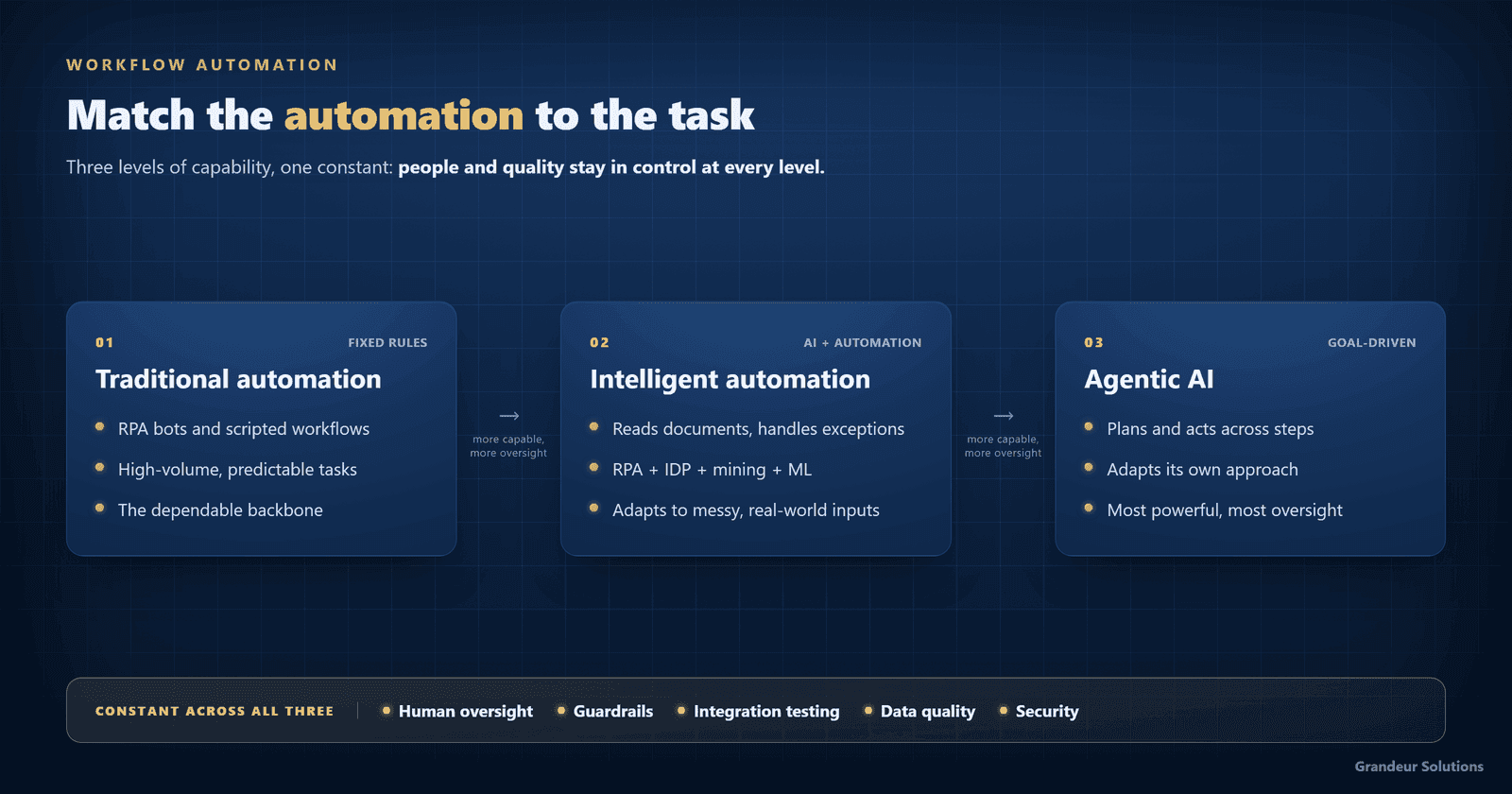
These terms are often blurred, but they sit on a ladder of capability, and knowing which you need keeps expectations and risk in check. Match the tool to the task: Forrester has noted that deterministic, rule-based automation still runs the core of most long-running business processes, while McKinsey groups real agentic work into human-led workflows, agent-led workflows with a human in the loop, and fully agentic systems. Most organizations will use all three for years.
- Traditional automation follows fixed rules. RPA bots and scripted workflows excel at high-volume, predictable tasks, and they remain the dependable backbone of most operations.
- Intelligent automation adds AI to the mix, combining RPA, document processing, process mining, and machine learning so a workflow can handle judgment, unstructured inputs, and exceptions.
- Agentic AI goes further still, pursuing a goal across multiple steps and adapting its approach rather than following a script. It is the newest and most powerful, and the one that most needs oversight.
Common mistakes, and how to avoid them
Most automation efforts fail for predictable reasons, and the common thread is skipping the groundwork.
- Automating a broken workflow. Technology on top of a bad process just produces bad results faster. Optimize first, then automate.
- Choosing the tool before the requirement. Buying software before understanding the work is the most common and costly mistake.
- Leaving people out. Without the involvement of those who run the workflow, and proper training, adoption stalls and resistance grows.
- Weak integration and poor data quality. Disconnected systems and inaccurate data undermine any automation built on top of them.
- Insufficient testing and weak access controls. Automation that moves real data and takes real actions needs the same rigor as any production system, security included.
- Over-relying on automation without oversight, and not monitoring performance. Set guardrails, keep a human in the loop for high-stakes steps, and watch the metrics so new bottlenecks surface early.
Where AI and technology fit, responsibly
The guiding principle is simple: AI should enhance a well-designed workflow, not automate a bad one. Used that way, modern tools can recommend improvements, read and route documents, integrate applications through APIs, trigger notifications and approvals, and increasingly carry out routine multi-step tasks. But intelligent automation acts on data, and it acts at scale, which means weak data, broken integrations, or missing oversight are amplified too. That is why successful workflow automation depends on more than the software. It depends on reliable integration, rigorous testing, strong cybersecurity and access controls, data protection, clear governance, and human oversight for decisions that carry financial, legal, or customer risk. These are quality and engineering questions, and they are what separate automation leaders can trust from automation that quietly creates new problems.
How Grandeur Solutions approaches workflow optimization
At Grandeur Solutions, we help organizations optimize how work gets done and make the technology behind it dependable. Our work spans IT consulting and technology advisory, business process and workflow improvement, and the quality engineering disciplines that keep automated systems reliable, from software quality assurance and test automation to API and integration testing, performance and regression testing, and cloud and DevOps quality. That combination is the point. Successful workflow optimization is not one purchase; it is process assessment, the right technology choice, disciplined integration and testing, and continuous improvement, working together. An automated workflow is only as trustworthy as the integrations and data behind it, which is why we treat quality and governance as part of the design, not an afterthought. We help organizations find where bottlenecks and risk really live, choose automation that fits the problem rather than the trend, validate it before it goes live, and measure the results. If you are looking to eliminate operational friction, modernize how work flows across your business, or evaluate where intelligent automation genuinely fits, we would welcome the conversation at grandeurbusinesssolutions.com.
References
- McKinsey & Company, The agentic organization: Contours of the next paradigm for the AI era (2025)
- McKinsey & Company, One year of agentic AI: Six lessons from the people doing the work (2025)
- AIIM, Market Momentum Index: Intelligent Document Processing (IDP) Survey 2025
- Forrester, Predictions 2025: GenAI, Citizen Developers, And Caution Influence Automation
- Deloitte, Global Process Mining Survey 2025 (February 2025)
- Gartner, Worldwide Low-Code Development Technologies Market forecast (newsroom)
- IBM, What is intelligent automation?
Frequently asked questions
Ready to deliver software with confidence?
Book a free discovery call. We'll learn about your goals and show you exactly how we can help no obligation.